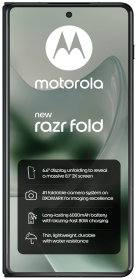
The Motorola Razr Fold is Motorola's first large-format book-style foldable, putting it in direct competition with the Samsung Galaxy Z Fold7 rather than its own clamshell Razr line. At 243g it is heavier than the Z Fold7 (215g), but pairs that with an 8.1-inch inner display and a 6.6-inch cover screen, the largest on any current book-style fold.
Razr Fold: Display
The 8.1-inch foldable inner panel is an OLED screen with a 120Hz refresh rate for smooth scrolling, and the 6.6-inch cover display runs at up to 165Hz. Both support Dolby Vision and HDR10+, and the cover is protected by Corning's Gorilla Glass Ceramic 3. Motorola quotes a peak brightness that should mean the inner panel stays readable in direct sunlight.
The 165Hz cover refresh rate is locked to gaming use through Motorola's utility, with most apps capped at 120Hz. The headline is a gaming peak, not a general benefit.
Razr Fold: Camera
The triple 50-megapixel rear system pairs a wide main camera with stabilisation to reduce blur, a 3x optical zoom periscope, and a 122-degree ultrawide. That gives the Razr Fold a real telephoto reach the Samsung Galaxy Z Fold7 lacks, since Samsung dropped its dedicated zoom lens this generation in favour of cropping from its 200-megapixel main sensor. Video runs to 8K at 30fps with Dolby Vision.
Motorola has not historically been a top-tier camera brand at this price point, and the Z Fold7's larger main sensor is likely to hold an edge in low light.
Razr Fold: Battery
The 6,000mAh silicon-carbon battery is the largest in any current book-style foldable sold in the UK, paired with 80W wired, 50W wireless and reverse wireless charging. The Z Fold7 carries a 4,400mAh cell with 25W wired and lasted 11 hours and 44 minutes in GSMArena's lab test. The Razr Fold's battery is 36 per cent larger, which on paper should mean longer use between charges.
The box does not include a plug, so buyers will need a high-wattage USB-PD charger to reach peak speeds.
Razr Fold: Size, Weight and Build
Unfolded, the Razr Fold measures 160.1 by 144.5 by 4.7mm; folded, it is 160.1 by 73.6 by 10.1mm. It is thicker when closed than the Z Fold7 (8.9mm folded) and weighs 28g more, with an aluminium frame and stylus support. The Z Fold7 dropped S Pen support this year, leaving the Razr Fold the more capable note-taking option.
The trade-off is ingress protection. The Razr Fold is rated IPX9, protected against immersion to 1.5 metres for 30 minutes but with no dust resistance certification. The Z Fold7 and the in-house clamshell Motorola Razr 60 Ultra are both rated IP48, which adds dust protection.
Razr Fold: Performance
The Razr Fold uses Qualcomm's Snapdragon 8 Gen 5, paired with 12GB of memory on the 256GB model or 16GB on the 512GB and 1TB versions. Motorola has committed to up to seven major Android upgrades from launch with Android 16, matching Samsung's window. None have been delivered yet.
Foldables in this segment have historically throttled under sustained load due to limited cooling space. Buyers planning long gaming sessions should expect the Razr Fold to follow that pattern.
Razr Fold: Who Should Buy
The Razr Fold is the strongest pick for buyers who want the largest cover screen, 3x optical zoom and stylus support in a book-style foldable, and accept a thicker, heavier body and weaker dust rating in return. Buyers who prioritise the thinnest, lightest foldable, or who are committed to Samsung's One UI ecosystem, will find the Z Fold7 a closer fit. Buyers comparing on contract length or cost will find current network pricing in the table above.